Communicable Disease Toolkit for School Nurses
Disclaimer: This toolkit is intended to provide resources for school nursing practice as it relates to the response and mitigation of communicable diseases in Oregon Schools. This is not medical or nurse practice advice, and is not prescriptive as it relates to individual students or individual nursing practice. These resources do not override individual assessment and clinical judgment. Nurses are responsible for their own assessments and practice.
Introduction
Communicable disease control and prevention is of significant importance in creating a safe and healthy environment for students and staff. In the school setting, communicable disease prevention is grounded in education, role modeling, and standard hygiene precautions. However, as population-based environments, schools must also establish practices and interventions to address actual or potential exposures, a process in which school nursing plays an essential role.
A communicable disease prevention and management plan is a required component of the prevention-oriented health services plan required under OAR 581-022-2220 (Health Services). This communicable disease management plan should include school-level protocols that address notification of the local public health authority (LPHA) when student or staff absenteeism due to illness reaches thresholds established by the Oregon Health Authority (OHA) or LPHA; exclusion of individuals in accordance with OAR 333-019-0010, including the provision of an appropriately supervised and adequately equipped isolation space designated exclusively for the care of a sick child while on school premises; implementation of mitigation measures when warranted by case activity or as recommended by the OHA or LPHA; identification of and response to the needs of students who are at increased risk for severe disease outcomes or loss of access to education due to a communicable disease; and response to the mental health impacts of a communicable disease outbreak within the school community.
Basics of Communicable Disease Management
A communicable disease is an infectious disease transmissible by contact with infected individuals or their bodily discharges or fluids, by contact with contaminated surfaces or objects, by ingestion of contaminated food or water, or by direct or indirect contact with disease vectors. Although the terms infectious disease, communicable disease and contagious disease are often used interchangeably, it is important to note that not all infectious diseases that are spread by contact with disease vectors are considered to be "contagious" diseases since they cannot be spread from direct contact with another person (ACPHD, 2013).
Communicable Diseases may be categorized in a variety of ways when considering population settings. When categorizing communicable diseases for response-oriented processes, one such method of categorization includes acuity and frequency (Augello, 2005). This allows individual operationalizing communicable disease prevention and response to identify the potential severity of a condition.
-
Low acuity, low frequency: Communicable diseases that are not uncommon but typically occur sporadically and pose low risk to the general school population in terms of morbidity and mortality (e.g., fifth disease, impetigo).
-
Low acuity, high frequency: Communicable diseases that are very common in pediatric populations and pose little risk of significant morbidity and mortality to the general school population (e.g., common cold, norovirus, hand, foot, and mouth disease).
-
Medium acuity, medium frequency: Communicable diseases that pose a slightly heightened risk of morbidity and mortality on an infrequent or seasonal basis in subsets of school populations (e.g., influenza, parainfluenza).
-
High acuity, low frequency: Communicable diseases that have greater potential severity in infected populations, with less predictable trends or unestablished seasonality, and that pose an increased risk of morbidity and mortality to the school population or subsets of the school population (e.g., meningococcal disease, E. coli).
Modes of Transmission
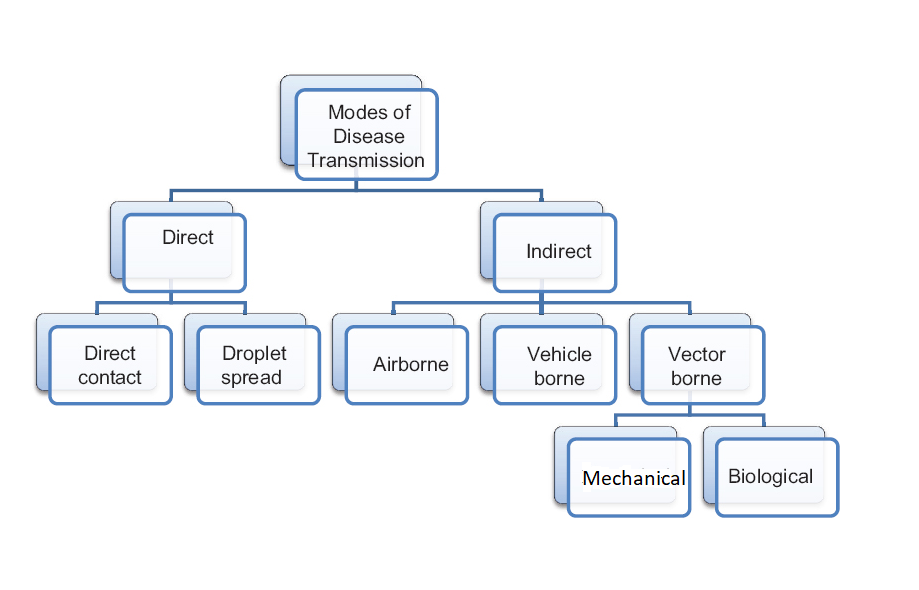
How communicable diseases are spread depends on the specific infectious agent. Common ways in which communicable diseases spread include direct contact and indirect contact:
-
Direct physical contact with an infected person: such as through touch (staphylococcus), sexual intercourse (gonorrhea, HIV), fecal-oral transmission (hepatitis A), or respiratory droplets (influenza, pertussis, TB).
-
Direct contact with contaminated surfaces or substances: such as surfaces or objects (norovirus), food (salmonella, E. coli), blood (HIV, hepatitis B, hepatitis C), or water (cholera, listeria).
-
Vector-borne transmission: bites from insects or animals capable of transmitting disease (mosquitoes: malaria and yellow fever; fleas: plague).
-
Airborne transmission: aerosolized spread through the air (measles).
Levels of Prevention
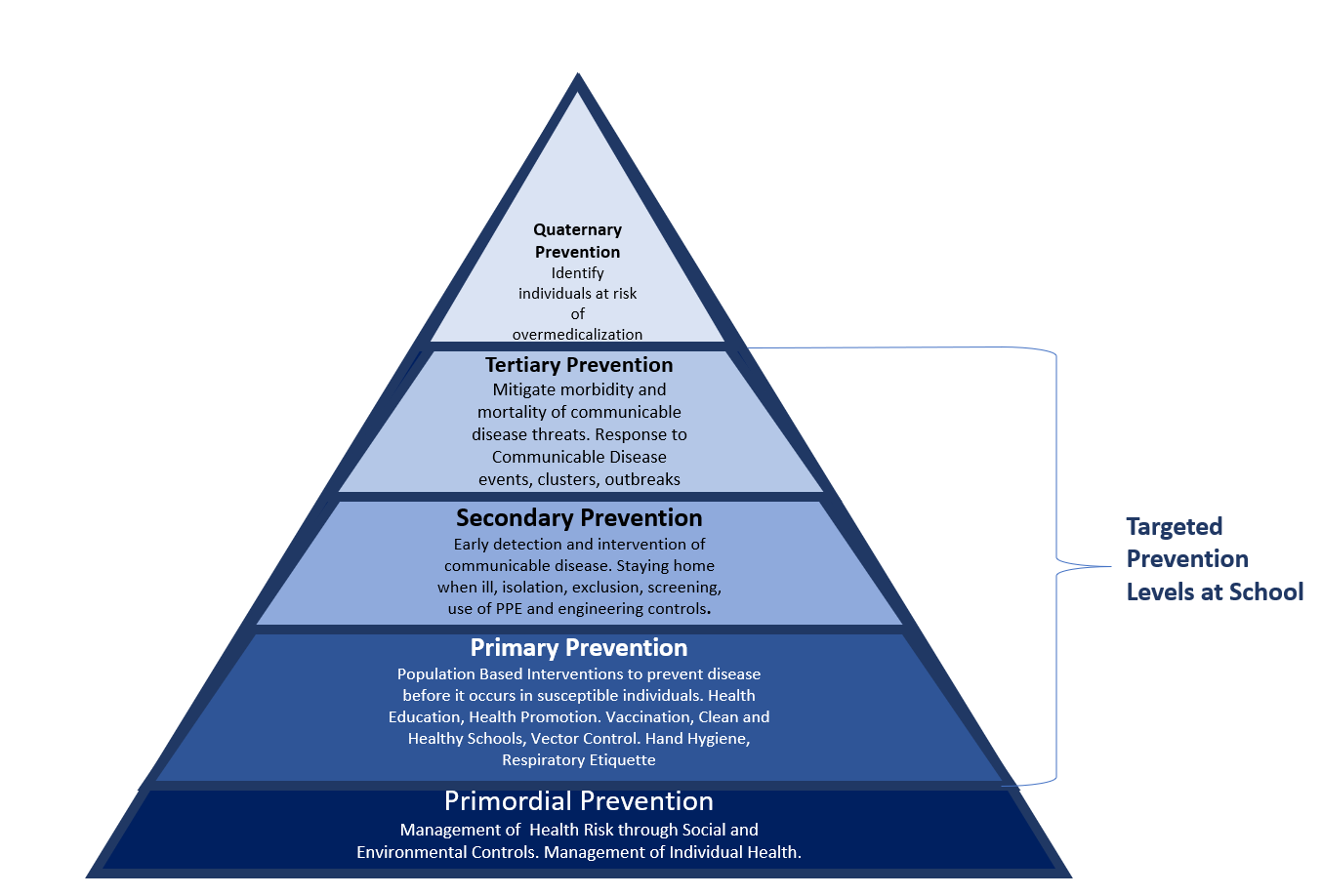
Levels of Prevention are regarded as essential public health operations to protect and improve overall health of populations and communities (WHO, 2022). Endorsing a leveled approach to communicable disease management creates a framework of embedding prevention at every level of management and response [ i.e. preventing disease, preventing spread, preventing complications, preventing sequelae].
Building a Communicable Disease Management Team
The development and implementation of a district communicable disease plan requires an interdisciplinary approach, with input from multiple stakeholders and subject-matter experts. Effective communication is essential both to establish preventive measures and to ensure appropriate management when an incident occurs. School staff should be familiar with FERPA requirements related to sharing student information during a public health emergency (see Oregon School Nurse Manual, section 2D).
Legal Practice Standards
Nurses should be familiar with their own scope of practice and with communicable disease management requirements in the school setting.
Evidence Based Practice
Public Access Practice Resources
Note: the following are national or regional resources that serve as a reference; they may or may not be consistent with Oregon law and do not supersede Oregon Nurse Practice requirements.
American Academy of Pediatrics (AAP)
Centers for Disease Control and Prevention (CDC)
Oregon Health Authority (OHA) / Oregon Department of Education (ODE)
Professional Development
Disease-Specific Information for Nurses
For additional guidance regarding school exclusion, reference OHA/ODE Guidelines.
Measles
Norovirus
Seasonal Influenza
Varicella
COVID-19
Tools and Templates
The following tools are modifiable for use by school nurses as it relates to their practice, and should always be implemented in alignment with Oregon State Board of Nursing delegation laws and local school district policy.
Collaboration with LPHA
School nurses operate as the bridge between the healthcare and educational systems, and are therefore in an ideal position to facilitate collaboration with Local Public Health Authorities (LPHA) regarding communicable disease management.
Communicable Disease Prevention and Management Plans
The Communicable Disease Prevention and Management Plan provides comprehensive direction for infection control guidance, practice standards, and school level protocols.
OSNA School District Communicable Disease Plan Sample. An editable version of the sample Communicable Disease Management Plan is available here. The PDF is here.
Multnomah Education Service District Comprehensive Communicable Disease Management Plan
Appropriate attributions to MESD must be provided if you choose to edit this plan.
Handwashing
Practicing of and accessibility to hand hygiene is a simple yet effective way to prevent infections. Hand hygiene, which means cleaning your hands by washing with soap and water or using an alcohol-based hand sanitizer containing at least 60% alcohol, is one of the best ways to avoid getting sick and prevent spreading germs to others.
Head Lice-Not a Communicable Disease
According to the AAP, “ head lice are neither a health hazard nor a sign of poor hygiene and are not responsible for the spread of any disease.” The school nurse can serve as an advocate for evidence-based school policies and reinforce that head lice are NOT considered a communicable disease.
Isolation Space
The school district shall maintain a prevention oriented health services program (OAR 581-022-2220) for all students which provides: Health care and space that is appropriately supervised and adequately equipped for providing first aid, and isolates the sick or injured child from the student body. (ODE)
Mental Health
Mental health is a vital component of student, staff and community health and wellbeing. Support, education and discussion on ways to increase mental health in our schools are found here.
Symptom Surveillance
Symptom surveillance/monitoring is the practice of collecting symptom data and watching for trends of illness in specific populations. Symptom monitoring can be done at the baseline or preventative level and modified to collect additional information during times of increased illness or high transmission risk.
Vaccinations
In the school setting, vaccination is a critical component of communicable disease control. In Oregon, vaccines are required for school attendance. However, some individuals may be unvaccinated due to medical contraindications or approved non-medical exemptions. Collaboration with Human Resources may be necessary to ensure staff vaccination compliance if directed by LPHA during an outbreak.
References
Alameda County Public Health Department. (2013). Communicable disease. http://www.acphd.org/communicable-disease.aspx
ASCD (Association for Supervision and Curriculum Development). (2020). Whole School, Whole Community, Whole Child (WSCC). http://www.ascd.org/programs/learning-and-health/wscc-model.aspx
BC Centre for Disease Control. (2009). A quick guide to common childhood diseases.http://www.bccdc.ca/resourcegallery/Documents/Guidelines%20and%20Forms/Guidelines%20and%20Manuals/Epid/Other/Epid_GF_childhood_quickguide_may_09.pdf
Centers for Disease Control and Prevention. (2016a). Bloodborne pathogens.https://www.cdc.gov/niosh/topics/bbp/emergnedl.html
Centers for Disease Control and Prevention. (2016b). Variant influenza viruses: Background and CDC risk assessment and reporting. https://www.cdc.gov/flu/swineflu/variant.htm
Centers for Disease Control and Prevention. (2017). Getting your school ready for pandemic flu.https://www.cdc.gov/nonpharmaceutical-interventions/pdf/gr-pan-flu-ed-set.pdf
Centers for Disease Control and Prevention. (2020a). Influenza. https://www.cdc.gov/flu/about/index.html
Centers for Disease Control and Prevention. (2020b). When and how to wash your hands.https://www.cdc.gov/handwashing/whenhow_handwashing.html
Centers for Disease Control and Prevention. (2024a). About handwashing. https://www.cdc.gov/clean-hands/about/index.html
Centers for Disease Control and Prevention. (2024b). Preventing spread of infections in K–12 schools.https://www.cdc.gov/orr/school-preparedness/infection-prevention/index.html
Centers for Disease Control and Prevention. (2024c). Science brief: Prevention and control of respiratory and gastrointestinal infections in kindergarten through grade 12 (K–12) schools. https://www.cdc.gov/orr/school-preparedness/infection-prevention/docs/IPC-Science-Brief_508.pdf
Minnesota Department of Health. (2020). Teaching hand hygiene.https://www.health.state.mn.us/people/handhygiene/curricula/index.html
Montana Department of Public Health and Human Services. (2018). Communicable disease: A guide for schools in Montana. https://dphhs.mt.gov/Portals/85/publichealth/documents/CDEpi/CDGuideforSchools2018_Final.pdf
Myers, N. T., Laumbach, R. J., Black, K. G., Ohman-Strickland, P., Alimokhtari, S., Legard, A., De Resende, A., Calderón, L., Lu, F. T., Mainelis, G., & Kipen, H. M. (2022). Portable air cleaners and residential exposure to SARS-CoV-2 aerosols: A real-world study. Indoor Air, 32(4), e13029. https://doi.org/10.1111/ina.13029
National Association of School Nurses. (n.d.). Working with local public health officials, state and local authorities.https://schoolnursenet.nasn.org/covid19ref/glossary/working-with-local-public-health-officials-state-and-local-authorities
National Resource Center for Health and Safety in Child Care and Early Education. (2020). Environmental health in early care and education. https://nrckids.org/CFOC/Environmental_Health
Oregon Department of Education. (2024). Communicable disease guidance for schools.https://www.oregon.gov/ode/students-and-family/healthsafety/Documents/Updated%20CD%20Guidance.pdf
Oregon Department of Education. (2025). School level communicable disease planning.https://www.oregon.gov/ode/students-and-family/healthsafety/pages/communicable-disease-planning.aspx
South Dakota Department of Health. (2019). Seasonal respiratory viruses. https://doh.sd.gov/topics/diseases/infectious-diseases/respiratory-virus-guidance/
Tyson, M. E., Bohl, D. D., & Blickman, J. G. (2014). A randomized controlled trial: Child life services in pediatric imaging. Pediatric Radiology, 44(11), 1426–1432. https://doi.org/10.1007/s00247-014-3005-1
U.S. Department of Health and Human Services. (2023). Public health. https://www.hhs.gov/hipaa/for-professionals/special-topics/public-health/index.html
Verbeek, J. H., Rajamaki, B., Ijaz, S., Sauni, R., Toomey, E., Blackwood, B., Tikka, C., Ruotsalainen, J. H., & Kilinc Balci, F. S. (2020). Personal protective equipment for preventing highly infectious diseases due to exposure to contaminated body fluids in healthcare staff. Cochrane Database of Systematic Reviews, 4(4), CD011621. https://doi.org/10.1002/14651858.CD011621.pub4
Victoria State Government. (2020). Managing spills of blood and body fluids and substances.https://www.health.vic.gov.au/infectious-diseases/managing-spills-of-blood-and-body-fluids-and-substances
Villers, J., Henriques, A., Calarco, S., Rognlien, M., Mounet, N., Devine, J., Azzopardi, G., Elson, P., Andreini, M., Tarocco, N., Vassella, C., & Keiser, O. (2022). SARS-CoV-2 aerosol transmission in schools: The effectiveness of different interventions. Swiss Medical Weekly, 152(21–22), w30178. https://doi.org/10.4414/smw.2022.w30178
Virginia Department of Health. (2011). FAQ: Respiratory hygiene and cough etiquette.https://www.vdh.virginia.gov/content/uploads/sites/3/2016/01/RespiratoryHygieneCoughEtiquette_FAQ.pdf
Weatherspoon, D. (2019). Acute viral respiratory infections. https://www.healthline.com/health/acute-respiratory-disease
Images:
|
|
-
Open University
-
Prepare.gov
-
Safety Signs
|
-
Slideserve
-
Science Direct
|
Revised January 2026